


Interpretation of Advantages of Public‑Network Body‑Worn Recorders New Option for Wide‑Area Coverage and Cross‑Regional Dispatching
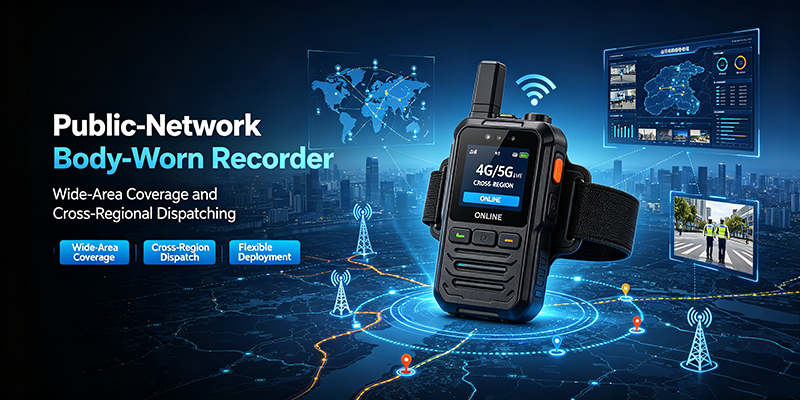
Traditional privatenetwork communication devices suffer from limited coverage and high costs for crossregional collaboration. Relying on public mobile communication networks, publicnetwork bodyworn recorders realize widearea coverage and flexible deployment and are becoming a new choice for multisite joint operations. This article interprets core strengths and applicable scenarios of publicnetwork bodyworn recorders.
1. WideArea Coverage: Break Geographical Restrictions
The most prominent advantage of publicnetwork bodyworn recorders lies in extensive coverage. The device works normally wherever mobilenetwork signals are available, maintaining connectivity in urban blocks as well as remote towns. It is especially critical for mobile tasks across different regions; personnel will not lose contact when moving out of privatenetwork coverage. With continuous improvement of 4G and 5G networks, signal blind spots keep shrinking and the usability of publicnetwork bodyworn recorders continues to rise.
2. CrossRegional Dispatching: Simplify MultiSite Collaboration
Supported by publicnetwork platforms, publicnetwork bodyworn recorders enable unified crossregional and crossdepartment dispatching. Personnel from different cities and organizations can join the same communication group for voice intercom and video backhaul. This capability proves particularly valuable for largeevent security and crossregional joint missions. Command centers view locations and live video streams of all online staff via a unified console, and dispatch the nearest personnel with oneclick operations, greatly improving collaboration efficiency.
3. Flexible Deployment: No SelfBuilt BaseStations Required
Traditional privatenetwork communication demands selfbuilt base stations and relay equipment, which bring heavy investment and long construction cycles. Publicnetwork bodyworn recorders require no extra infrastructure investment and are readytouse upon poweron, making them ideal for temporary missions and mobile teams. Relatively low hardware costs facilitate largescale equipment rollout. For organizations with limited budgets yet requiring widerange communication capacity, publicnetwork bodyworn recorders deliver high costperformance.
4. Rich Functions: Platform Empowers More Possibilities
Supporting management platforms for publicnetwork bodyworn recorders provide abundant features. Besides basic voice intercom and video streaming, they offer electronic maps, track playback, electronic fencing and task assignment. Some platforms support interconnection with videosurveillance systems and emergency command systems to build integrated commandanddispatch architectures. Cloud storage automatically saves video clips and call logs for easy postevent retrieval and archiving.
Summary
Featuring widearea coverage, crossregional dispatching, flexible deployment and versatile functions, publicnetwork bodyworn recorders bring brandnew solutions for multisite collaborative operations. Requiring no privatenetwork construction, with controllable costs and instant usability, they fit work scenarios involving largerange mobility and crossregional cooperation. Adopting publicnetwork bodyworn recorders means choosing a more flexible and efficient mobileoperation mode.


