


5G Body‑Worn Recorders Lead New Revolution in On‑Site Recording Technical Breakthroughs of Ultra‑Low Latency and High‑Definition Transmission
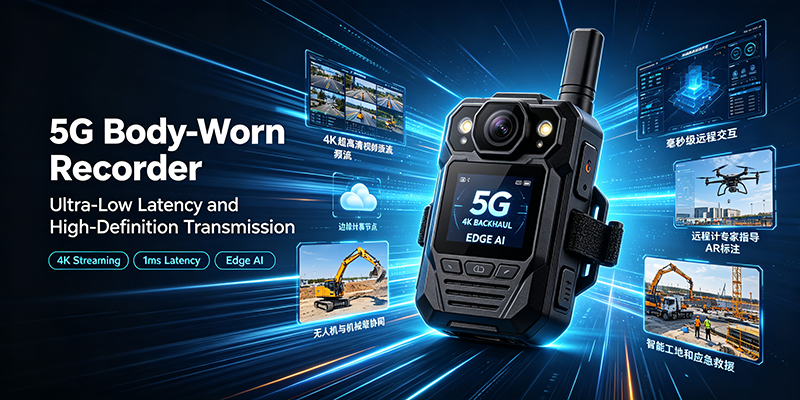
The commercial rollout of 5thgeneration mobile communication technology is bringing revolutionary changes to onsite recording. Boasting three core technical features — ultrahigh bandwidth, ultralow latency and massivescale connectivity, 5G bodyworn recorders push onsite video transmission to an entirely new level. From realtime 4K ultraHD backhaul to millisecondlevel remote control, 5G bodyworn recorders unlock many application scenarios that were previously impossible. This article delves into the transformative changes brought by 5G technology for onsite recording.
1. UltraHigh Bandwidth: RealTime 4K HighDefinition Transmission Becomes Reality
5G networks deliver peak download speeds up to 20 Gbps and uplink speeds reaching 10 Gbps, dozens of times faster than 4G networks. This enables 5G bodyworn recorders to effortlessly stream 4K ultraHD video with exquisite finegrained details. For scenarios requiring close observation, such as equipment defect inspection, document verification and traceevidence documentation, 4K resolution clearly presents critical details and delivers reliable visual references for remote decisionmaking.
High bandwidth also supports simultaneous multichannel video transmission. Some devices are equipped with dual cameras to stream panoramic and closeup footage synchronously, allowing remote operators to switch perspectives freely. When multiple units go online concurrently, the highcapacity characteristic of 5G networks guarantees transmission quality for every device.
2. UltraLow Latency: Technical Foundation for RealTime Remote Interaction
Endtoend latency of 5G networks can drop as low as 1 millisecond, far below the 50millisecond latency of 4G networks. This feature enables outstanding performance for 5G bodyworn recorders in realtime remoteinteraction scenarios. During remote expert guidance, remote experts view onsite footage with negligible delay and issue operational instructions instantly, while field personnel execute commands synchronously, achieving fluid performance comparable to facetoface communication.
Ultralow latency also makes remotecontroloriented applications feasible. For example, paired with robotic arms or drones, operators conduct remote manipulation based on live feeds from 5G bodyworn recorders with nearly imperceptible lag. In hazardousenvironment operations, such remotecontrol capability effectively safeguards personnel safety, allowing finegrained operations while keeping staff out of danger zones.
3. Edge Computing: More Efficient Intelligent Processing
The integration of 5G networks and edge computing represents another major technical highlight of 5G bodyworn recorders. By deploying computing nodes at network edges, AI processing tasks such as video analysis are completed close to data sources, instead of sending all raw data back to central servers. This not only lowers bandwidth consumption but also drastically cuts processing response time.
In practical deployment, 5G bodyworn recorders leverage edge computing to realize intelligent functions including realtime face recognition, licenseplate recognition and abnormalbehavior detection. Recognition results are returned within milliseconds and field operators receive instant alert notifications, delivering far faster response than traditional solutions.
4. Typical Application Scenarios
At smart construction sites, 5G bodyworn recorders stream 4K highdefinition footage live to remote supervision centers, enabling experts to remotely inspect construction quality and safetystandard compliance. In emergency medical rescue, first responders wearing 5G bodyworn recorders transmit onsite footage to hospitals in realtime, allowing doctors to guide onsite rescue operations remotely and win precious time for patients. For industrial inspections, 5G bodyworn recorders work with AR glasses to realize collaborative remote expert maintenance; annotations from experts are overlaid onto live onsite footage to boost maintenance efficiency.
5. Deployment and Usage Recommendations
As 5G network coverage continues expanding, dualmode devices supporting both 5G and 4G are recommended. They automatically downgrade to 4G under poorsignal conditions to maintain uninterrupted connectivity. 4K video consumes substantial traffic; configure automatic highdefinition file upload over WiFi and standarddefinition streaming over cellular networks. Since 5G bodyworn recorders draw high power, deploy highcapacity batteries or portable power banks.
Summary
Featuring ultrahigh bandwidth, ultralow latency and edgecomputing capabilities, 5G bodyworn recorders spearhead newera transformation for onsite recording. As 5G coverage expands and application ecosystems mature, 5G bodyworn recorders will play critical roles across more industries, bringing unprecedented efficiency gains and experience upgrades for field operations.


