


Forward‑Looking Interpretation of 5G Two‑Way Radios Next‑Generation Communication Equipment with Ultra‑Low Latency and Large Bandwidth
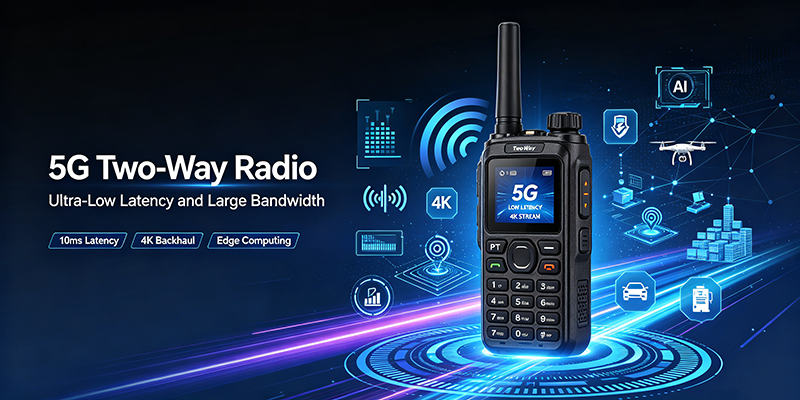
The arrival of the 5G era is redefining the boundaries of mobile communications. Leveraging 5G network capabilities including ultralow latency, large bandwidth and massivescale device connectivity, 5G twoway radios elevate teamcommunication performance to an entirely new level. This article provides forwardlooking insights into their technical characteristics and futureoriented applications.
1. UltraLow Latency: MillisecondLevel Command Response
Endtoend latency of 5G networks can drop as low as 10 milliseconds, achieving nearrealtime synchronization. Voice calls and instruction delivery over 5G twoway radios incur barely perceptible delay, enabling natural and fluid fronttoback communication comparable to facetoface interaction. For timecritical scenarios such as highspeed pursuits, emergency rescue and industrial control, millisecondlevel latency delivers faster response and higher missionsuccess rates. Twoway video calls run smoothly without stalling or lag; remote expert guidance feels just like onsite presence. Such ultralowlatency performance cannot be matched by 4G twoway radios.
2. Large Bandwidth: Simultaneous MultiChannel HighDefinition Video Transmission
5G networks deliver uplink peak rates above 1 Gbps, allowing 5G twoway radios to easily stream 4K ultraHD video in realtime with fourtimes higher resolution than conventional 1080P footage. More importantly, 5G supports concurrent multichannel highdefinition video transmission. Multiple 5G twoway radios can feed live onsite footage simultaneously, enabling command centers to obtain comprehensive multiangle situational awareness. Multiview streaming brings great value for largeevent security and emergencyincident disposal. Builtin AI intelligent analysis identifies targets and detects anomalies across multichannel video feeds and triggers automatic alerts.
3. Edge Computing: More Efficient Intelligent Analysis
Paired with 5G edgecomputing nodes, 5G twoway radios complete video analytics and data processing at network edges instead of transmitting all raw data back to central servers. This eases serverside pressure and drastically cuts analysis latency. AI tasks such as face recognition, behavior analysis and object detection run locally on edge nodes, with results returned within seconds. Edge computing also enables local data caching to prevent data loss during network fluctuations; automatic retransmission activates once connectivity recovers. This cloudedge collaborative architecture makes intelligent applications for 5G twoway radios more efficient and reliable.
4. MassiveScale Connectivity: LargeScale Team Collaboration
5G networks support up to millions of connected devices per square kilometer, so 5G twoway radios easily accommodate massive numbers of concurrent online users. For largescale events, exhibitions and sports gatherings requiring communication support for thousands of personnel, 5G networks avoid congestion and disconnection. Devicetodevice (D2D) direct communication is also available: when network infrastructure suffers damage, radios establish direct links among themselves to maintain basic communication capability. High reliability and high capacity make 5G twoway radios ideal for largeteam and missioncritical communication.
Summary
Featuring ultralow latency, large bandwidth, edge computing and massivescale connectivity, 5G twoway radios set new benchmarks for nextgeneration teamcommunication hardware. They are more than communication gadgets; they act as frontend nodes within intelligent command systems. As 5G infrastructure keeps improving and application ecosystems keep expanding, 5G twoway radios will play greater roles across diverse scenarios and push teamcommunication toward intelligence, high efficiency and full visualization.


