


5G Body‑Worn Recorder Technical Analysis Next‑Generation Law‑Enforcement Equipment with Ultra‑Low Latency and High‑Definition Backhaul
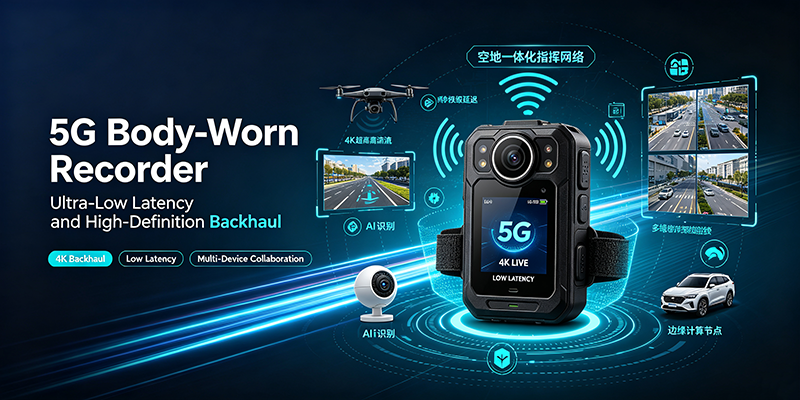
The arrival of the 5G era brings revolutionary upgrades for mobile lawenforcement hardware. Leveraging 5G network characteristics of large bandwidth and low latency, 5G bodyworn recorders realize realtime 4K ultraHD video backhaul and millisecondlevel command response, evolving into core nextgeneration mobilelawenforcement equipment. This article provides indepth analysis on technical features and application value of 5G bodyworn recorders.
1. UltraHD Video Backhaul: Every Detail Visible
5G networks deliver peak downlink rates up to 10 Gbps, with uplink performance far exceeding 4G. 5G bodyworn recorders easily achieve realtime 4K ultraHD video streaming, offering fourtimes higher definition than conventional 1080P footage. Command centers observe every onsite detail including text signs, facial features and object particulars to support precise decisionmaking. For scenarios requiring remote expert guidance, ultraHD backhaul makes experts feel virtually present for more accurate judgments.
2. UltraLow Latency: Timely Command Response
Endtoend latency of 5G networks can drop as low as 10 milliseconds, achieving nearrealtime synchronization. Video streams and command instructions transmitted via 5G bodyworn recorders suffer barely perceptible delay; decisions from command centers are instantly delivered to frontline staff. For timecritical missions such as highspeed pursuits and emergency rescue, lowlatency performance accelerates response and raises missionsuccess rates. Twoway video calls also become smooth and natural, similar to facetoface conversations.
3. MultiDevice Collaboration: Build Intelligent Command Networks
5G networks support massivescale device connections. 5G bodyworn recorders can connect alongside drones, PTZ deployment cameras and vehiclemounted terminals onto one unified command platform, constructing airground integrated intelligentcommand networks. Multiple video feeds stream simultaneously for comprehensive situational awareness at command centers. AI intelligent analysis identifies targets and detects anomalies across multichannel video streams and triggers automatic alerts to make command operations smarter and more efficient.
4. Edge Computing: More Efficient Data Processing
When paired with 5G edgecomputing nodes, 5G bodyworn recorders complete video analysis and data processing at network edges instead of sending all raw data back to central servers. This eases serverside pressure and drastically cuts analysis latency. AI tasks such as face recognition and behavior analysis are executed on edge nodes with results returned within seconds. Edge computing also enables local data caching to prevent data loss during network fluctuations and resume transmission automatically once connectivity recovers.
Summary
Equipped with ultraHD backhaul, ultralow latency, multidevice collaboration and edgecomputing capabilities, 5G bodyworn recorders set new standards for nextgeneration mobilelawenforcement hardware. They are more than recording and communication tools; they act as frontend nodes within intelligentcommand systems. As 5G infrastructure continues to improve, 5G bodyworn recorders will play greater roles across diverse scenarios and push mobile lawenforcement toward intelligence and higher efficiency.


