


Buying Guide for Mobile PTZ Deployment Cameras Flexible‑Deployment & Ready‑to‑Use Mobile‑Surveillance Solutions
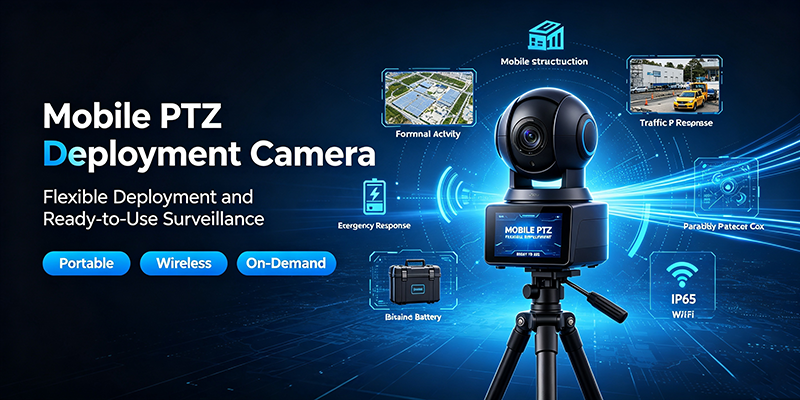
Surveillance demands are often dynamic, and fixed cameras cannot cover every scenario. Featuring flexible deployment and readytogo operation, mobile PTZ deployment cameras deliver ideal solutions for changing monitoring requirements. This article introduces purchasing essentials and operational advantages of mobile PTZ deployment cameras.
1. Flexible Deployment: Deploy Wherever Needed
The greatest strength of mobile PTZ deployment cameras lies in flexible setup. Housed inside spherical enclosures, the units mount rapidly on tripods, magnetic bases or portable brackets on any flat surface. No drilling or cabling is required; they operate right out of the box. For usecases requiring frequent position shifts such as mobile construction sites, temporary events, traffic control and emergency response, mobile PTZ deployment cameras can be flexibly deployed permission requirements and quickly dismantled upon task completion. Such flexibility is unmatched by fixed surveillance hardware, enabling dynamic allocation of monitoring resources to where they are most needed.
2. Portable Design: EasytoCarry Hardware
Mobile PTZ deployment cameras are engineered for portability. Most models weigh less than 2 kilograms and fit inside carrying cases or backpacks for easy transportation to any site. Builtin batteries support multihour continuous runtime without external power supply. Some allinone designs integrate camera, PTZ mechanism, battery and 4G module within the spherical housing for maximum convenience during transport and operation. Thanks to portable construction, mobile PTZ deployment cameras can arrive onsite together with field staff and establish monitoring points immediately.
3. Wireless Connectivity: Free From Cable Restraints
Modern mobile PTZ deployment cameras commonly support 4G/5G and WiFi wireless connections. Video streams transmit over wireless networks with no video cabling required. Devices can therefore be deployed at any location with cellular signal, unrestricted by cable length. They function reliably at outdoor construction zones, temporaryevent venues and remote sites lacking wirednetwork infrastructure. Selected models support pointtopoint wireless transmission for direct links to local receiving hardware even without public network coverage.
4. Purchasing Essentials: Match Configurations to Actual Scenarios
When selecting mobile PTZ deployment cameras, prioritize portability; weight and formfactor are key indicators. Models under 2 kg supplied with a carrying case are recommended. For mounting options, tripods offer universal compatibility while magnetic bases enable fast attachment to metal surfaces. Video resolution should be 1080P or higher, with PTZ supporting 360degree horizontal rotation. For wireless connectivity, prefer dualmode units supporting 4G fullnetcom and WiFi. For battery performance, builtin batteries should deliver no less than 6 hours of continuous operation; fastcharging and externalpower input are desirable extras. Ingressprotection rating of IP65 or above is advised for outdoor harshcondition adaptability.
Summary
With flexible deployment, portable build and wireless connectivity, mobile PTZ deployment cameras provide efficient solutions for dynamicsurveillance requirements. Deployable on demand, easy to transport and cablefree, they are particularly suitable for temporary and mobilemonitoring scenarios. When purchasing, evaluate portability, mounting methods, video quality, wireless capabilities, battery life and ingress protection according to realworld usage scenarios to select suitable mobile PTZ deployment cameras and achieve ondemand allocation of surveillance assets.


