


Application Guide for Emergency Command & Dispatching Platform Command System for Rapid Emergency Response and Collaborative Disposal
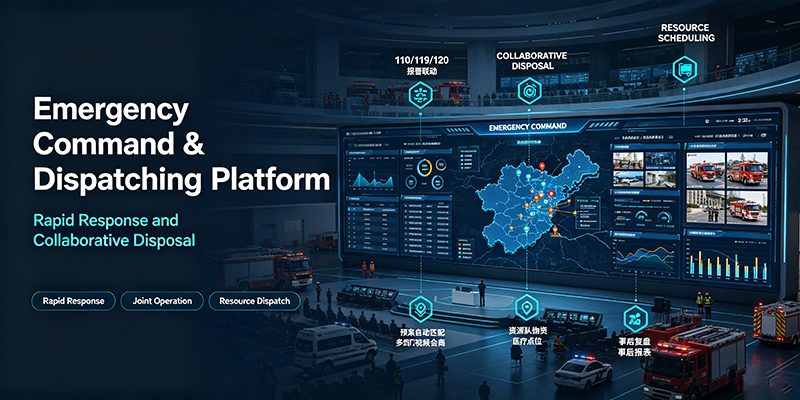
Emergencies are characterized by sudden onset, complexity and hazard, placing extremely high requirements on emergencycommand capabilities. Through rapid response, collaborative disposal and resource scheduling, emergency command & dispatching platforms deliver professional commandsystem support for emergencyincident handling. This article presents an application guide for such platforms.
1. Rapid Response: Grasp Situational Awareness Immediately Upon Incident
When emergencies occur, every minute counts. Emergency command & dispatching platforms collect multisource information at the earliest possible stage. The platform connects to alarm systems such as 110,119,120 to automatically pull incident details and location; it quickly accesses nearby surveillance cameras for livescene viewing; relevant personnel and departments receive notifications to trigger emergency response workflows. Incident positions, hazard impact zones and surrounding resources are marked on electronic maps to help commanders rapidly understand overall conditions. Automaticplanmatching logic recommends preestablished emergency response plans according to incident type and severity to guide initial onsite disposal. Rapidresponse functions win precious time for emergency handling.
2. Collaborative Disposal: MultiDepartment Joint Operations
Emergency incident resolution frequently requires crossdepartment joint efforts. Emergency command & dispatching platforms deliver powerful collaborativedisposal capabilities. Multidepartment and multihierarchy users log in simultaneously and work together under a unified command framework. Videoconferencing enables facetoface consultation and joint decisionmaking among department leaders. Taskassignment functions decompose disposal workflows to departments and individuals and track task progress. Informationsharing modules allow all participants to access realtime onsite updates and handling progress to eliminate information asymmetry. Crossdepartment collaboration transforms isolated individual responses into coordinated joint operations and improves disposal efficiency and outcomes significantly.
3. Resource Dispatching: Optimize Allocation of Emergency Assets
Emergency command & dispatching platforms realize unified administration and intelligent scheduling of emergency resources. A builtin emergencyresource database records emergency teams, supplies & equipment, shelters and medical institutions, marking their locations and status on electronic maps. Once an incident happens, the platform automatically recommends nearby available assets according to incident location and category to assist commanders with fast deployment. Resourcetracking monitors realtime location and status of dispatched assets to guarantee timely arrival. Resourcestatistics track consumption throughout response operations to support reasonable replenishment and redistribution. Optimized resource scheduling maximizes output from limited emergency assets.
4. PostIncident Review: Summarize Experience for Continuous Improvement
Postincident review is essential to upgrade overall emergencyresponse capacity. Emergency command & dispatching platforms record fullprocess data including incident timelines, dispatching orders, resource deployment, communication logs and video footage. The system autogenerates chronological timelines and summary reports to facilitate postevent debriefing. Dataanalysis evaluates response workflows and identifies gaps in response speed, resource allocation and interdepartment coordination. Review outputs are used to revise emergency plans, optimize resource layouts and organize training drills for sustained improvement of emergencycommand competency. The platform serves not only realtime emergency handling but also postincident capability enhancement.
Summary
Premised on rapid response, centered on collaborative disposal, supported by resource dispatching and extended via postincident review modules, emergency command & dispatching platforms provide endtoend commandsystem support for emergencyincident management. They accelerate emergency reaction, boost crossagency collaboration, optimize resource allocation and enable systematic experience summarization. Deploying a fullyfeatured, stable and reliable emergency command & dispatching platform constitutes a vital measure to strengthen emergencyincident handling capability and safeguard people’s lives and property.


